Choosing a Vehicle Caliper supplier for international sourcing involves more than comparing quoted prices. Buyers need to assess braking performance, durability, dimensional consistency, and supply reliability across different vehicle platforms. A caliper’s finish, piston seals, and sliding surfaces can reveal important differences in production control. Small details matter.
This guide examines supplier capabilities, including material selection, machining processes, quality checks, traceability, production capacity, and delivery planning. It also considers how suppliers support original equipment and replacement-part needs, since the two markets may call for different specifications and service expectations. Ask for clear product data and test documentation, then confirm that the offered caliper fits the intended application. Requirements can vary by vehicle and market, so verify relevant certifications and technical documentation directly with each supplier. A polished catalog is useful, but it does not prove consistent performance. No checklist catches everything.
For global buyers, communication and responsiveness matter alongside factory capability. Samples, inspection records, and realistic lead-time discussions can help identify gaps before a large order is placed. Yet comparisons are rarely perfect: supplier data may use different methods, and a sample cannot represent every production batch. Treat this as a practical starting point, not a guarantee. The sections ahead outline how to compare suppliers, ask focused questions, and weigh cost against evidence, consistency, and long-term support. A careful review can make sourcing decisions more informed, even when some uncertainty remains.
Vehicle Calipers: Understanding the Main Types
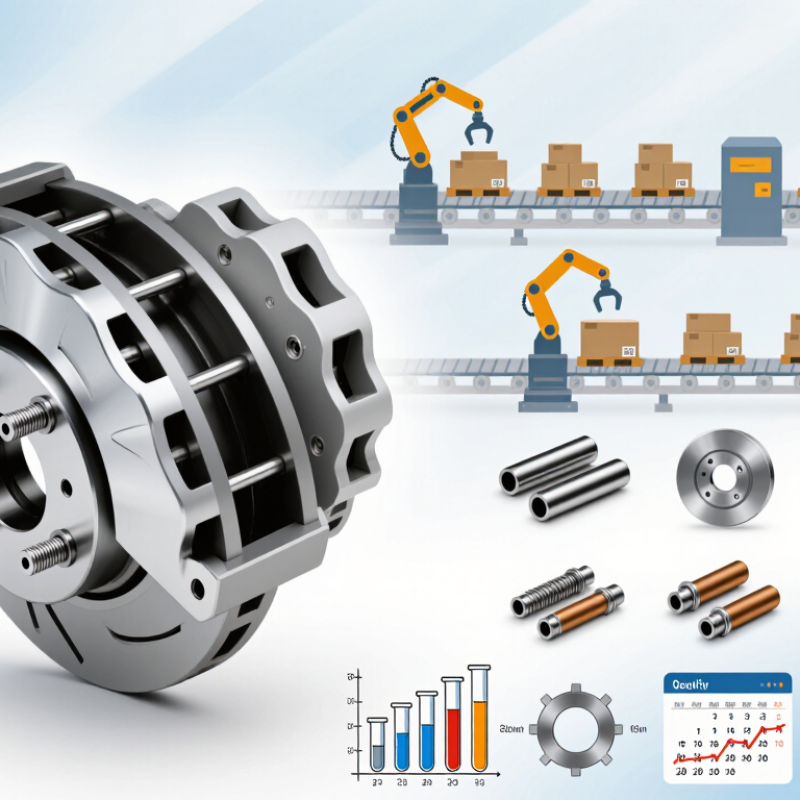
A vehicle caliper presses brake pads against a rotating disc, converting hydraulic pressure into friction. The two common designs are floating, also called sliding, calipers and fixed calipers. A floating caliper moves on guide pins and usually has pistons on one side. A fixed caliper stays in place and uses pistons on both sides. Simple distinction. For buyers, construction affects packaging, service needs, heat management, and cost; it does not alone determine braking performance.
OICA’s 2023 production statistics report about 93.5 million motor vehicles produced worldwide. That scale highlights why consistent specifications matter across vehicle platforms, though production totals are not caliper sales figures. Buyers should compare piston count and bore, mounting dimensions, material, dust-boot protection, and compatibility with the intended disc and pads. A cast-iron body may suit cost-sensitive applications, while aluminum can reduce component mass. Yet lighter is not automatically better: design, testing, and operating conditions matter.
Tips: Ask suppliers for dimensional drawings, material specifications, corrosion-test details, and traceable inspection records. Check whether replacement seals and guide-pin parts are available. A neat finish is reassuring, but it cannot prove durability. Even experienced teams can miss small fitment differences, so verify against the vehicle’s actual requirements before approving samples.
| Caliper Type | Construction and Operation | Common Applications | Main Advantages | Buyer Considerations | Useful Supplier Information |
|---|---|---|---|---|---|
| Floating or Sliding Caliper | Usually has pistons on one side of the rotor. The caliper moves on guide pins or slides so the outer pad is pressed against the opposite side of the rotor. | Common on passenger cars and light vehicles, particularly on front or rear disc-brake systems where the vehicle design specifies this layout. | Compact construction and fewer pistons can make it a practical choice for many standard-duty applications. | Check guide-pin condition, mounting dimensions, piston diameter, pad shape, and whether the design is compatible with the vehicle’s original brake system. | Request application coverage, dimensional drawings, material and coating details, and information about seals and included hardware. |
| Fixed Caliper | Bolts rigidly to the suspension or axle assembly and does not slide. Pistons are arranged on both sides of the rotor. | Used on some passenger vehicles, higher-performance vehicles, and heavier-duty applications, depending on the vehicle’s braking design. | Opposing pistons apply force from both sides of the rotor; the design can support larger pad areas and multiple pistons. | Confirm piston count and layout, rotor thickness and diameter, mounting points, brake-hose connection, and required clearance. | Ask for verified fitment data, piston configuration, pressure and leak-test procedures, and documentation for the intended market. |
| Single-Piston Caliper | Uses one hydraulic piston. It is commonly configured as a floating caliper, with caliper movement applying the outer pad. | Found in many standard passenger-car disc-brake applications; exact use depends on vehicle weight and brake-system design. | Relatively straightforward construction and service procedures. | Match the piston diameter, housing shape, mounting bracket, and pad specification to the exact vehicle application. | Request vehicle-specific interchange or fitment references rather than relying on appearance alone. |
| Multi-Piston Caliper | Uses multiple pistons, often arranged in opposing pairs in a fixed caliper. Piston sizes and positions may vary within the same caliper. | Used where a vehicle’s braking package calls for a larger pad area or a particular force distribution, including some performance and heavy-duty systems. | Can provide a larger pad-contact area and distribute clamping force across the pad according to the system design. | Verify piston count, piston diameters and locations, bleed-point arrangement, rotor dimensions, pad shape, and wheel clearance. | Request detailed technical drawings and confirmation that replacement parts are matched to the original brake-system specification. |
| Rear Caliper with Integrated Parking Brake | Combines hydraulic service-brake operation with a mechanical parking-brake mechanism in the caliper assembly. | Used on vehicles whose rear disc-brake design integrates the parking brake into the rear caliper. | Combines two braking functions in one assembly when specified by the vehicle design. | Check the parking-brake lever or actuator arrangement, cable connection, piston reset procedure, and left/right-side fitment. | Confirm whether the assembly includes the required lever, bracket, or hardware and obtain installation and adjustment guidance. |
| Remanufactured Caliper | A previously used caliper housing that has been inspected and reconditioned; serviceable components may be replaced or refinished according to the remanufacturing process. | Used as a replacement option where a correctly specified remanufactured unit is available for the vehicle application. | Can reuse a serviceable housing and may be offered with a return-core program, depending on the supplier and market. | Ask what components are replaced, how the housing is inspected, what tests are performed, and whether a core deposit or return is required. | Request process controls, traceability, warranty terms, packaging requirements, and clear disclosure of what is included in the unit. |
| New Replacement Caliper | A newly manufactured replacement assembly designed for a specified vehicle application and brake-system configuration. | Suitable when buyers need a new replacement unit and verified application coverage is available. | Does not depend on a used core, although construction, included components, and finish vary by product specification. | Compare fitment, materials, coating, seals, included brackets and hardware, packaging, and applicable quality documentation. | Request production and inspection details, batch traceability, test records, product drawings, and market-specific compliance information. |
| Global Sourcing Checks | Apply to every caliper type. Confirm the vehicle application using make, model, year, axle position, engine or trim where relevant, and original equipment references. | Consistent specifications and verified fitment help reduce returns and installation problems. | Clarify order quantities, lead times, packaging, shipping terms, warranty coverage, return procedures, and whether brake pads or mounting hardware are included. | Evaluate documented quality controls, inspection and testing methods, production capacity, export experience, technical support, and the supplier’s ability to provide accurate fitment records. | |
A caliper presses brake pads against a rotating disc. Hydraulic pressure creates friction and slows the vehicle. The caliper must move smoothly and seal properly.
A floating caliper slides on guide pins and usually has pistons on one side. A fixed caliper stays in place and uses pistons on both sides. The design affects packaging, servicing, and heat control.
Not necessarily. Braking performance depends on the complete system, including disc size, pad material, piston design, and testing. Caliper type alone is not enough.
Compare piston count, piston bore, mounting dimensions, material, seals, and dust-boot protection. Confirm compatibility with the intended disc and brake pads. Small fitment differences can cause expensive problems.
Aluminum can reduce component weight. Cast iron may suit cost-sensitive applications. Lighter does not automatically mean stronger, cooler, or more durable.
Request dimensional drawings, material specifications, corrosion-test details, and traceable inspection records. Ask for batch identification from raw material through final packing. Neat documents help, but they do not prove production quality.
Test leakage, piston movement, corrosion resistance, brake-fluid compatibility, and fatigue behavior. Use realistic operating conditions. A sample may pass while later batches vary.
Review machining accuracy, surface treatment, casting or forging controls, and pressure-testing procedures. Inspect measuring equipment and production-floor discipline. Certificates alone are not enough.
Check ongoing inspections, corrective-action records, response speed, and batch consistency. Ask how the supplier explains root causes. Even experienced teams can miss details, so approval should not be final.
This guide presents a practical framework for global buyers searching for reliable Vehicle Caliper suppliers in 2026. It explains the main caliper types, including fixed, floating, and sliding designs, and outlines how each may suit different vehicle platforms, braking requirements, and operating conditions. Buyers will also learn how to assess manufacturing capability, material consistency, dimensional accuracy, testing procedures, production capacity, delivery performance, and technical support before beginning cooperation.
The guide compares supplier quality, certifications, quality-control systems, export experience, and market coverage without focusing on any specific brand. It also provides a verification process covering factory audits, sample evaluation, documentation review, traceability, packaging, warranty terms, and communication standards. By applying these criteria, purchasers can reduce sourcing risks, identify suppliers that match their technical and commercial needs, and build dependable long-term supply relationships for safe, compliant, and consistent Vehicle Caliper procurement.

 BIT Automobile