Choosing the 2026 best EPB actuator types requires more than comparing prices or motor ratings. Global buyers must examine vehicle compatibility, environmental resistance, control logic, and supplier support. An Epb Actuator may look identical across models, yet its connector, gear ratio, mounting points, or software requirements can differ significantly. Fitment comes first.
This introduction explores common actuator designs, including integrated caliper units, cable-driven systems, and electronically controlled parking brake modules. Each type suits different vehicle platforms, production volumes, and maintenance strategies. Buyers should check operating voltage, clamping force, response time, sealing protection, noise levels, and cycle durability. A unit tested in a dry laboratory may behave differently after winter road salt, dust, heat, and repeated short trips. Details matter.
Reliable sourcing also depends on evidence. Technical drawings, validation reports, traceable materials, warranty terms, and documented quality procedures deserve careful review. Supplier communication is equally important, especially when regional connectors, left-hand-drive applications, or local service practices affect installation. No comparison is perfect. Catalog data can be incomplete, and laboratory results may not reflect every road condition. A practical decision should combine specifications, sample testing, installation feedback, and lifecycle cost. One choice rarely fits all. The strongest option is the actuator that delivers stable braking performance, straightforward integration, and dependable support across its intended market.
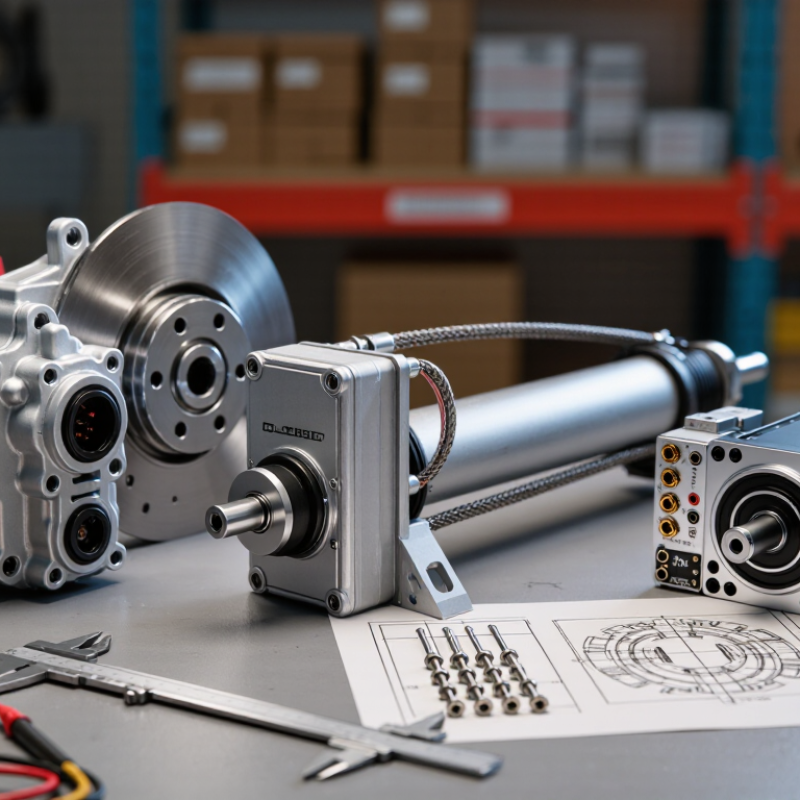
An EPB actuator converts electrical energy into clamping force at the rear brake. Common layouts include motor-on-caliper units, cable-pull modules, and spindle-driven mechanisms. The correct choice depends on packaging, axle load, brake geometry, and control strategy. Do not judge performance from motor voltage alone. A 12 V system suits many passenger vehicles and light platforms. A 24 V system can reduce current for similar power, especially in larger vehicle architectures. Yet voltage must match the vehicle network, driver electronics, connectors, and protection design.
During selection, measure peak current, applied force, stroke, response time, and holding force. Static holding force is not the same as clamp force at the pad. Duty cycle matters. A unit may tolerate one short application, then require cooling before another operation. Frequent parking events, hill-hold use, trailer loading, and emergency cycling can raise thermal stress. Use measured data from cold and hot conditions, because grease viscosity and seal friction change with temperature. In development work, I would record force against travel rather than trusting a single catalogue figure. A neat calculation can still mislead.
Environmental sealing, corrosion resistance, noise, and fail-safe release deserve equal attention. A compact actuator may fit perfectly but overheat during repeated testing. That result is easy to overlook. Buyers should request tolerance bands, endurance cycles, current limits, and test temperature ranges. Verify behavior during low voltage, connector loss, and controller reset. These checks expose weak assumptions before vehicle trials. The most useful specification is a traceable performance window under real duty conditions.
It converts electrical energy into clamping force at the rear brake. Common designs use calipers, cables, or spindle mechanisms. Packaging matters.
No. A 12 V system suits many passenger vehicles. A 24 V system can reduce current in larger architectures. Voltage must match the vehicle network, connectors, and control electronics.
Measure peak current, stroke, response time, applied force, and holding force. Static holding force does not equal pad clamp force. Record force against travel.
Repeated parking events create heat. Hill holding, trailer loading, and repeated cycling increase thermal stress. One short operation proves little.
Request complete-actuator tests from −40°C to +85°C. Cold grease thickens and seals stiffen. Hot conditions can increase resistance and age polymers.
No. It indicates strong resistance to high-pressure, heated water and road grime. It does not prove unlimited immersion resistance. That assumption can fail.
Request salt-spray duration, cyclic-corrosion results, coating thickness, and connector photographs. Inspect brackets and fasteners carefully. They may corrode before the housing.
Verify stationary holding on an 18% gradient under loaded conditions. Test hot, cold, low-voltage, and repeated-cycle behavior. A bench pass is not enough.
Cable-pull systems may simplify service and reduce replacement cost. Integrated calipers can reduce exposed connections. A cheaper actuator may create calibration or warranty costs later.
Measure motor noise at one metre, clamp-time consistency, release delay, and vibration after thermal cycling. There is no universal quietness limit. Field feedback still matters.
Selecting the right Epb Actuator in 2026 requires a balanced review of electrical, mechanical, environmental, safety, and commercial performance. Buyers should compare 12 V and 24 V systems by output force, operating speed, thermal behavior, and duty-cycle capability, while also evaluating motor-on-caliper and cable-pull designs for packaging flexibility, energy efficiency, installation complexity, and response time. These factors directly influence braking consistency, vehicle integration, and long-term serviceability.
Environmental requirements are equally important for global applications. Protection levels such as IP6K9K, operation from −40°C to +85°C, and verified corrosion resistance can help determine suitability for harsh climates and road conditions. In addition, the actuator’s development process should support ISO 26262 ASIL expectations and align with UNECE R13-H considerations for electronic parking brake systems. A practical scorecard should combine safety evidence, NVH performance, durability, supply stability, and total cost of ownership rather than focusing only on purchase price.

 BIT Automobile